


About us
Founded as a dedicated group for integrative physiology, the Laboratory of Neuro-Cardiac Crosstalk unites investigators with distinct, complementary expertise in stem cell biology, cellular biophysics, and advanced molecular imaging. While our team members bring established individual track records to the bench, our newly formed laboratory serves as a collaborative launchpad, combining our shared expertise and cutting-edge infrastructure to tackle the complex neuroscience of the cardiovascular system from a fresh perspective.
Our Mission
Our mission is to decode the cellular and molecular language of neuro-cardiac communication to explore relevant pathological states underlying cardiovascular and autonomic disorders. We strive to:
- Map the Neuro-Cardiac Axis: Elucidate the precise ion channel dynamics, signaling cascades, and electrophysiological mechanisms governing neuron-cardiomyocyte interactions.
- Innovate Human-Relevant Models: Build scalable, animal-free physiological platforms using patient-specific hiPSC-derived neurons and cardiomyocytes that accurately reflect human disease pathology.
Our Methodological Approach & Infrastructure
To capture the rapid, nanoscale events of neuro-cardiac communication, our laboratory integrates four core technological pillars:
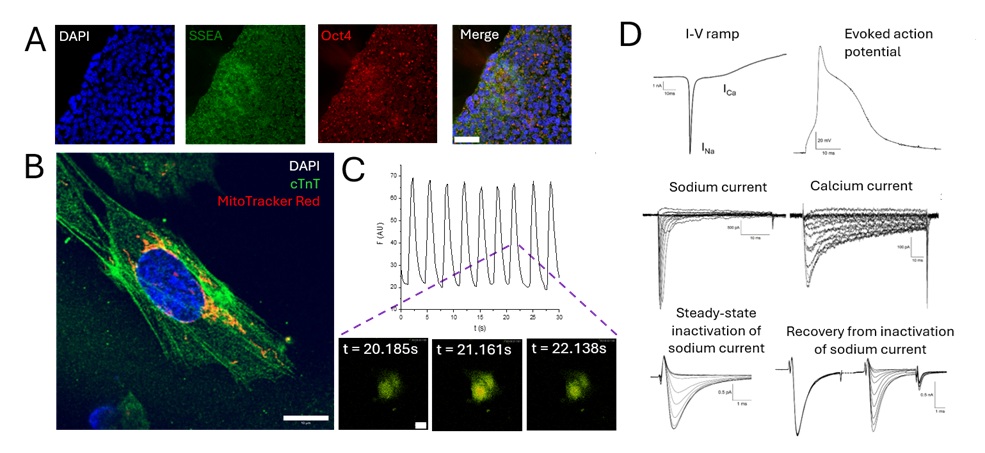
- Human Stem Cell Disease Modeling (hiPSCs). We utilize human induced pluripotent stem cells to differentiate human-specific cardiomyocytes and autonomic neurons. This allows us to construct the derived cells by itself as well as human-relevant co-culture models and study genetic cardiomyopathies without relying on animal models that often fail to mirror human cardiac electrophysiology.
- Single-Cell Electrophysiology (Whole-Cell Patch-Clamp). To understand how neural signaling alters cardiac rhythm, we employ whole-cell patch-clamp electrophysiology. This allows us to measure action potential duration, ion channel gating, and membrane currents at the individual cell level with sub-millisecond precision.
- Super-Resolution & Live-Cell Imaging (STED/Confocal). Using state-of-the-art confocal microscopy equipped with live-cell imaging capabilities and Stimulated Emission Depletion (STED) super-resolution technology, we aim to visualize the structural architecture of neuro-cardiac contact sites. We track real-time calcium transients, and structural remodeling of the organelles in living cells.
- Molecular & Transcriptomic Profiling (PCR & Western Blot). We correlate our functional and visual findings with underlying molecular shifts using quantitative PCR and Western blotting, mapping exactly how neurohumoral stress alters gene expression and protein phosphorylation cascades within the heart.
People
Mgr. Zuzana Ševčíková Tomášková, PhD.
dr. Norbert Weiss, PhD.
Mgr. Bohumila Jurkovičová Tarabová, PhD.
Mgr. Katarína Danko, PhD.
Mgr. Roman Dekhtiarenko
Selected publications
DEKHTIARENKO, Roman – POLČICOVÁ, Katarína – ŠEVČÍKOVÁ TOMÁŠKOVÁ, Zuzana**. Translocator protein in touch with mitochondrial chloride intracellular channel CLIC5. In Biochemical and Biophysical Research Communications, 2026, vol. 810, art. no. 153537. https://doi.org/10.1016/j.bbrc.2026.153537
JURKOVIČOVÁ TARABOVÁ, Bohumila – STRINGER, Robin N. – ŠEVČÍKOVÁ TOMÁŠKOVÁ, Zuzana – WEISS, Norbert**. Electrophysiological characterization of sourced human iPSC-derived motor neurons. In Channels, 2025, vol. 19, no. 1, art. no. 2480713. https://doi.org/10.1080/19336950.2025.2480713
GRMAN, Marián* – BALÁŽOVÁ, Mária* – HORVÁTH, Anton – POLČICOVÁ, Katarína – ONDÁČOVÁ, Katarína – ŠTEPANOVSKÝ, Jakub – ŠEVČÍKOVÁ TOMÁŠKOVÁ, Zuzana**. Lithium compromises the bioenergetic reserve of cardiomyoblasts mitochondria. In Journal of Bioenergetics and Biomembranes, 2025, vol. 57, no., p. 27-38. https://doi.org/10.1007/s10863-024-10050-x
STRINGER, Robin N. – WEISS, Norbert**. Pathophysiology of ion channels in amyotrophic lateral sclerosis. In Molecular Brain, 2023, vol. 16, no. 1, art. no. 82. https://doi.org/10.1186/s13041-023-01070-6
DE BORTOLI, Marzia** – MERAVIGLIA, Viviana – MACKOVÁ, Katarína – FROMMELT, Laura S. – KÖNIG, Eva – RAINER, Johannes – VOLANI, Chiara – BENZONI, Patrizia – SCHLITTER, Maja – CATTELAN, Giada – MOTTA, Benedetta M. – VOLPATO, Claudia – RAUHE, Werner – BARBUTI, Andrea – ZACCHIGNA, Serena – PRAMSTALLER, Peter P. – ROSSINI, Alexandra. Modeling incomplete penetrance in arrhythmogenic cardiomyopathy by human induced pluripotent stem cell derived cardiomyocytes. In Computational and Structural Biotechnology Journal, 2023, vol. 21, pp. 1759-1773. https://doi.org/10.1016/j.csbj.2023.02.029
STRINGER, Robin N.* – JURKOVIČOVÁ TARABOVÁ, Bohumila* – SOUZA, Ivana A. – IBRAHIM, Judy – VACÍK, Tomáš – FATHALLA, Waseem Mahmoud – HERTECANT, Jozef – ZAMPONI, Gerald W. – LACINOVÁ, Ľubica – WEISS, Norbert**. De novo SCN8A and inherited rare CACNA1H variants associated with severe developmental and epileptic encephalopathy. In Molecular Brain, 2021, vol. 14, no. 1, art. no. 126. https://doi.org/10.1186/s13041-021-00838-y
Ongoing & submitted projects
- Submitted EU-funded international BrainHealth Partnership project: MIND-AB. Maternal Immunity in NeuroDevelopment: How Autoantibodies shape Brain-health trajectories (B. Jurkovicova Tarabova, coordinator: Knut Kirmse, University of Würzburg)
- Submitted national APVV project: SYNDRA. Sympathetic neuro-cardiac mechanisms of arrhythmogenesis and SUDEP in Dravet syndrome revealed by patient-specific iPSC models (N. Weiss)
- Ongoing national VEGA project: Cardiac Dysfunction as a Central Contributor to sudden unexpected death in epilepsy in Dravet Syndrome: Mechanistic Insights from cardiomyocytes derived from patient – induced pluripotent stem cells (2026 – 2028, N. Weiss)
- Ongoing national APVV project: MCLICID. On the trace of the mitochondrial chloride channel identity (2023-2027, Z. Sevcikova Tomaskova)
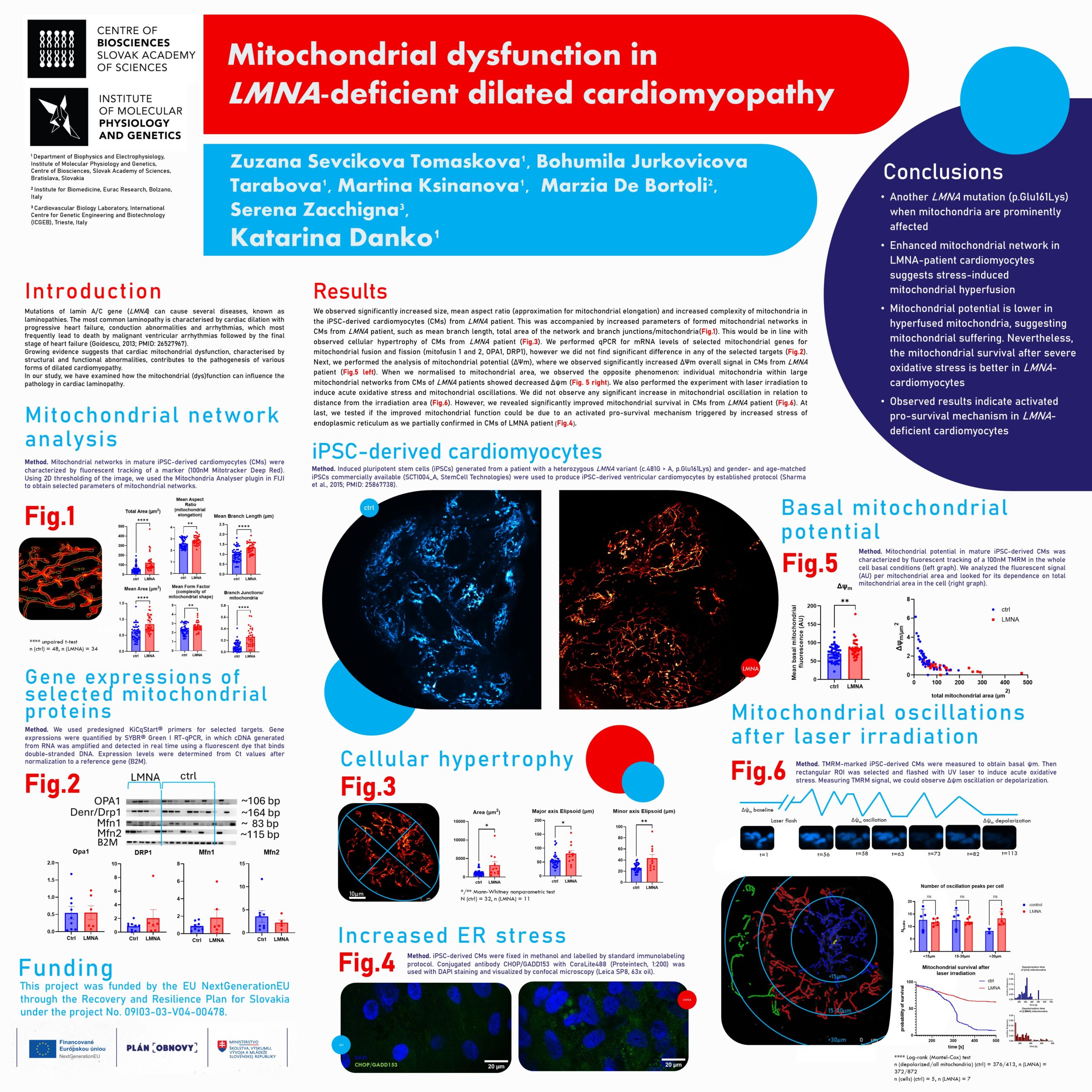
- Ongoing national R2 project: Nerves to heart: genetic cardiovascular diseases influenced by neuronal dysfunction on the model of dilated cardiomyopathy with Lamin A/C mutation (2024-2026, K. Danko)